My journey through mathematics
I think I have always been looking for patterns.
follow the pattern ↓
01 — Find
The YMCA floor
As a little kid, I would stare at the mosaic tiles on the floor of the YMCA swimming-pool locker room and try to decipher their design. A shape would repeat. Then disappear. Then return several tiles later. I would trace invisible lines across the floor, testing little theories in my head until suddenly…
Oh!
I saw it!
There was an absurd amount of satisfaction in that moment. I remember tugging my dad over to show him what I had found, explaining the pattern with enormous seriousness. When his face lit up in surprise, I felt a ridiculous, wonderful swell of pride: somehow, I had noticed something that even a grown-up hadn’t.
I didn't know it then, but I had just discovered one of my favorite feelings in the world.
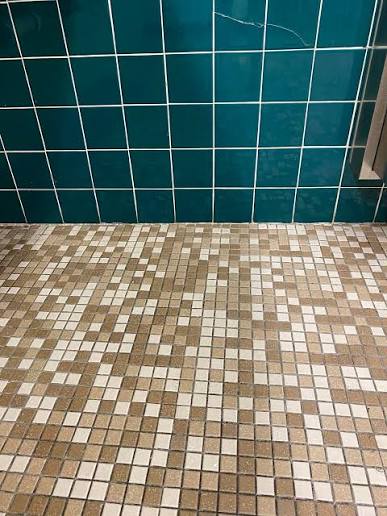
YMCA locker-room floor
02 — Solve
Patterns On Paper
When I was in first grade, my best friend dragged me to something called Math Kangaroo.
Number sequences. Strange diagrams. Little puzzles that looked completely different on the surface but somehow seemed to share the same hidden logic.
I was hooked almost instantly.
Winning first place nationally was exciting, of course. But what I remember more clearly was the satisfaction of finding an unexpectedly elegant way through a problem, the feeling that there was a clever structure hiding underneath, and I had managed to see it.
Naturally, I wanted harder patterns.
Competition mathematics became a huge part of my childhood. I got faster. I learned techniques. I filled notebooks with diagrams, modular arithmetic, and half-finished ideas.
And over time, I became very good at asking one particular question:
What’s the trick?
- Math Kangaroo
- AIME qualifier beginning in middle school
- perfect AMC 10
- multiple USAJMO qualifications
- USAJMO Honorable Mention
03 — Organize
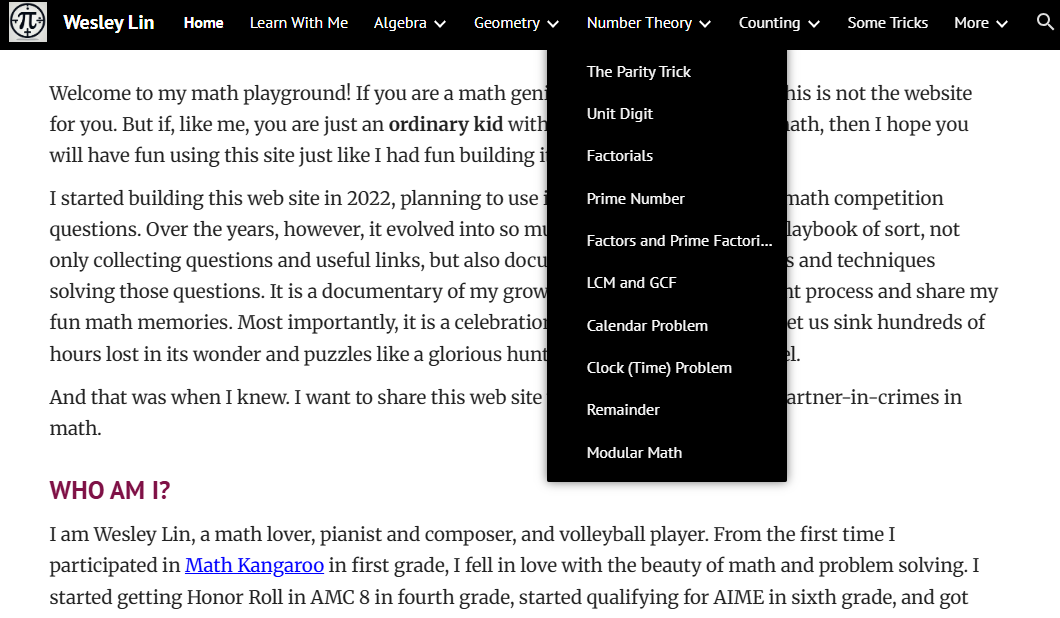
Eventually, I started organizing the patterns myself.
After competition problems, I began noticing something else. Problems that looked completely different on the surface often shared the same skeleton.
One might involve students around a table. Another might involve coloring tiles. Another might involve choosing ice-cream flavors. But underneath? The same idea.
I became fascinated not only with solving problems, but with sorting them by the ideas hiding behind them.
So I did something slightly ridiculous.
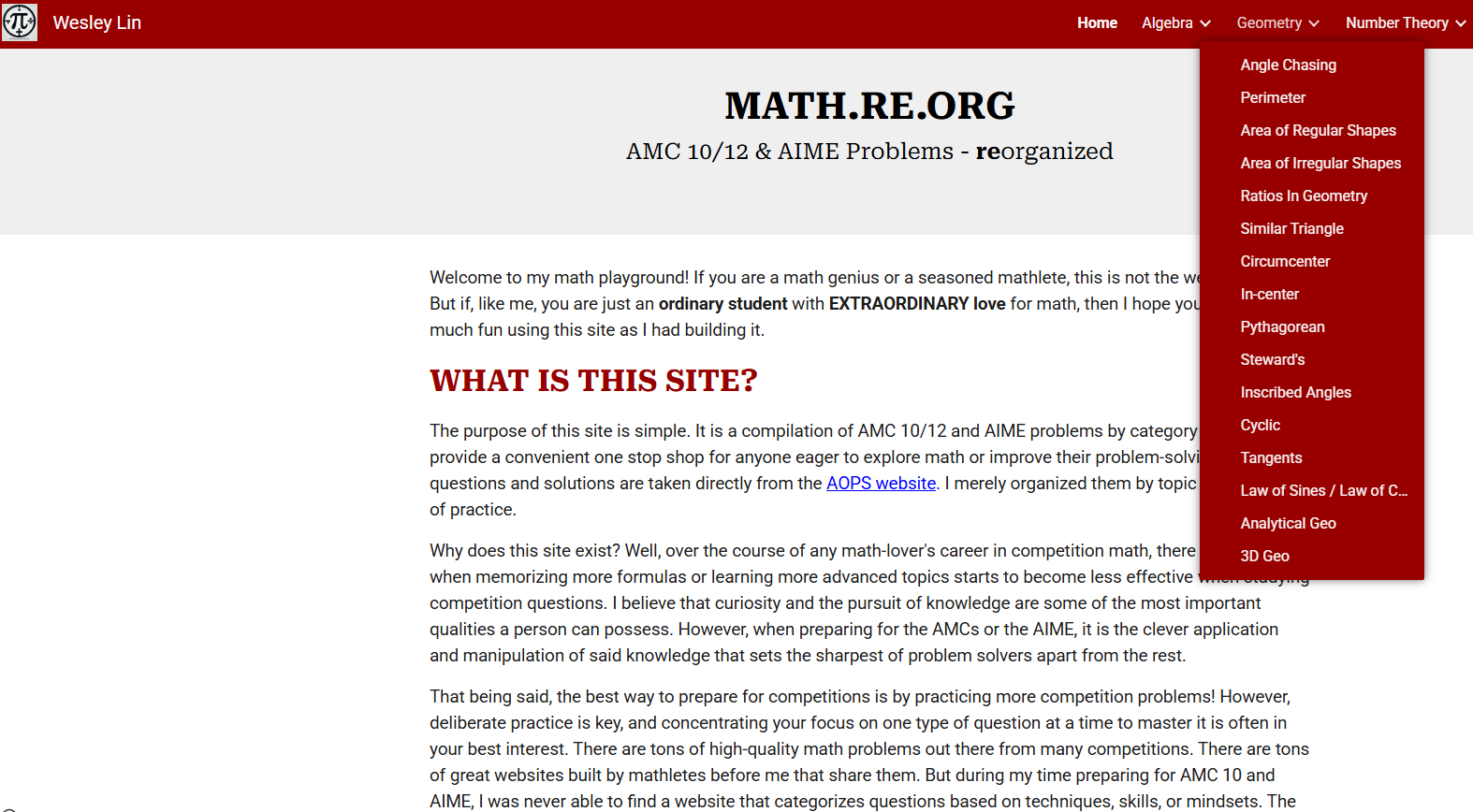
I manually went through years of AMC 8 problems and reorganized them by topic. Then I did the same thing for the AMC 10.
No AI. No automatic classifier. Mostly just me, hundreds of problems, and an unreasonable desire to put every problem where it belonged.
Hundreds of problems. One very long sorting project.
Thirty anonymous problem cards begin scattered at random and gradually sort themselves into five labelled columns: geometry, number theory, combinatorics, algebra and probability.
04 — Share
独乐乐,不若与众
There is an old Chinese saying: “独乐乐,不若与众乐乐” — joy is greater when it is shared.
As a pianist and composer, I have always understood that instinctively. Music comes alive differently when it leaves your own hands and reaches someone else.
What surprised me was discovering that mathematics works much the same way. When I began teaching younger students, those strange little websites I built became genuinely useful. Instead of telling someone to simply “practice more,” I could show them a family of related problems……
There is a special kind of joy in watching another person pause, look again, and suddenly say:
“Wait! .... I SEE IT!”
Somehow, their discovery lets me experience mine all over again.
- Fun Math Time with Wes — Taught elementary students through puzzles, games, origami, and pattern-based activities designed to make math feel playful and discoverable.
- Huaxia School AMC 8 Instructor — Taught AMC 8–level problem solving with a “problems first, formulas later” approach, emphasizing creativity over memorized tricks.
- AMC 8 / AMC 10 Classes — Used my self-built AMC 8 Reorganized and AMC 10 Reorganized problem banks to help students practice by concept and recognize recurring mathematical structures.
05 — Question
“How many pieces can you get from a watermelon with n cuts?”
That was one of the first questions I encountered at the Hampshire College Summer Studies in Mathematics.
“Easy!” I thought. My competition-trained brain immediately began rummaging around for formulas.
Except nobody wanted the formula.
What exactly counts as a cut?
Does the shape of the watermelon matter?
What if the watermelon were four-dimensional?
And suddenly the original problem had almost disappeared. For the next hour and a half, instead of racing toward an answer, we wandered happily through questions.
This was mathematics?
Then I went seven days without solving anything important.
During my second week at HCSSiM, I went seven days without solving a single major problem.
Competition-math-me hated this.
Every night I filled pages anyway.
But slowly, something changed.
“What am I missing?”
“What else is here?”
The hours when I had not solved the problem stopped feeling like wasted time.They became the mathematics.
06 — Connect
When patterns started talking to one another.
In information theory, we encountered a problem about storing information across files so that the original data could survive even when some files disappeared. I tried ordinary arithmetic. AND. OR. XOR. Nothing quite worked. We moved on.
Two weeks later, after studying finite fields, the old problem suddenly returned to me.
Wait.
What if the files weren't merely strings of bits? What if I treated them as elements of a four-element field? Suddenly, two subjects that had seemed unrelated snapped together. The pattern had been there all along. I simply hadn't learned the language needed to see it!
The mathematics I loved most was no longer finding the trick.It was discovering that two things I had never thought to connect were secretly one idea.
07 — Discover
Eventually, I realized what I had been looking for since the YMCA floor.
Structure.
That realization led me toward mathematical research.
Today, I spend my time thinking about knots, braids, representations, operators, and algebraic structures whose names my younger self could never have pronounced.
In MIT PRIMES, I began studying the Alexander polynomial of satellite knots through representation theory. Instead of simply solving a problem someone had carefully designed, I was entering questions whose paths were not predetermined.
There is no thirty-minute timer. No answer key.
Sometimes I don't even know whether the direction I'm following will lead anywhere.
And strangely— that is exactly what I love about it.
Maybe, I haven't changed that much.
Sometimes, I think mathematics has brought me in a circle. I started as a kid staring at colored tiles and wondering why they fit together the way they did. Then I learned to solve other people's patterns, and became very good at solving them. Then I organized them. Shared them. Questioned them. Connected them….
And eventually began searching for patterns no one had promised were there.
Today, I might be staring at knots, fields, operators, or equations instead of locker-room tiles. But the feeling is remarkably familiar. After all these years, I am still waiting for the same small miracle:
the moment the hidden pattern begins to emerge.
Wait…
I think I see something!