Math Community
America is like a Swiss cheese.
At least, that’s how I began thinking about mathematical opportunity.
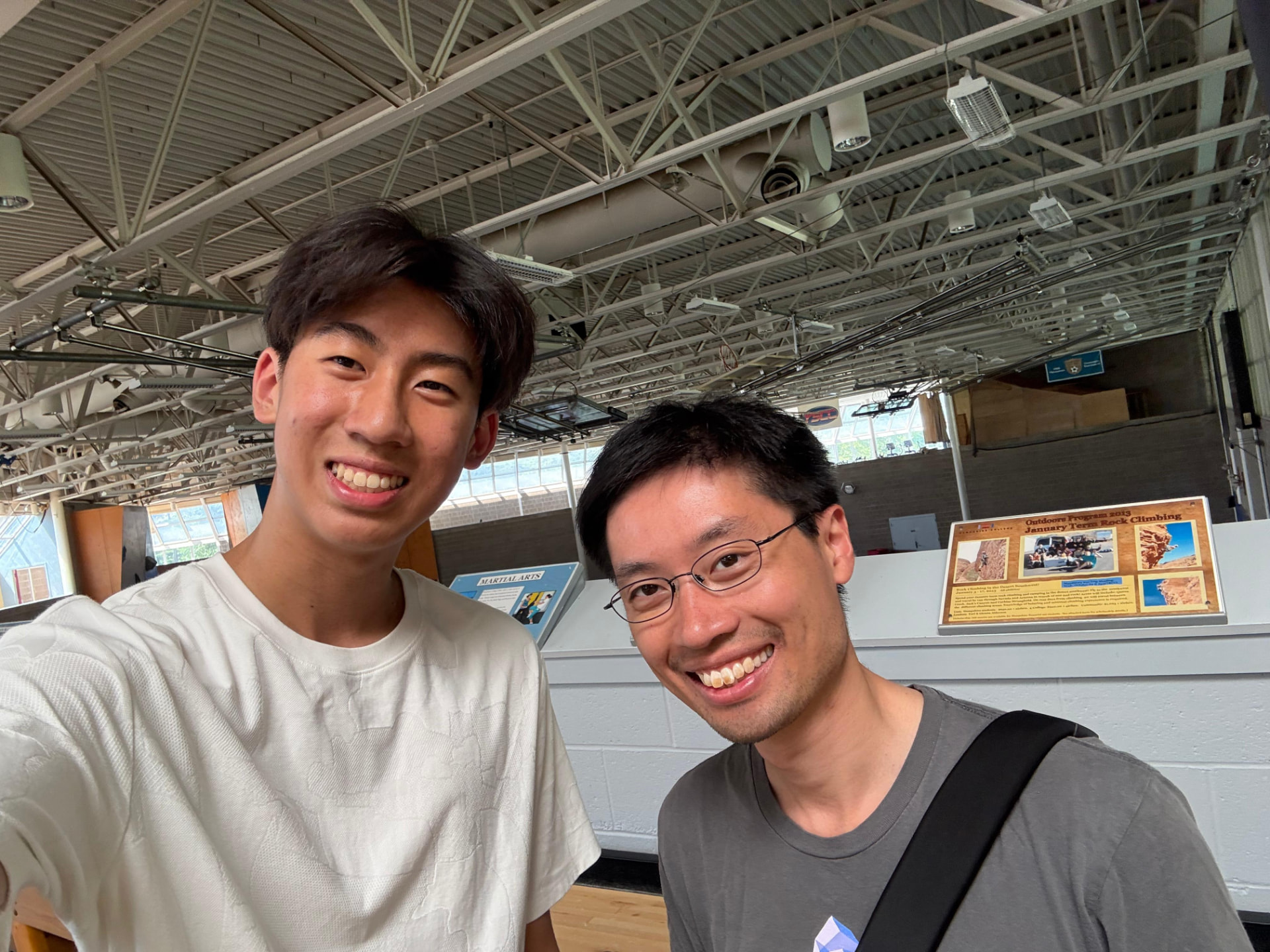
I was at HCSSiM, spending six weeks doing the kind of mathematics that had made me fall in love with the subject: exploratory, uncertain, collaborative, and wonderfully unnecessary, when Dr. Po-Shen Loh came to visit.
He spoke about an odd contradiction in American mathematics. In some places, students have extraordinary opportunities: Olympiad training, mathematical communities, advanced courses, and mentors. Yet not far away, another student may never encounter mathematics beyond a textbook.
That image stayed with me.
America is indeed like a Swiss cheese: full of remarkable pockets of mathematical opportunity, but also full of holes. Even worse, I realized that the holes aren’t only geographic.
Where do we lose the joy of mathematics?
I see three different holes, appearing at three different stages of a student’s mathematical life.
DISCOVER · The Joy Gap
The Joy Gap
Grades 1–5
For many children, mathematics first appears as arithmetic, procedures, worksheets, and getting the right answer.
But there is another mathematics: puzzles, patterns, surprising arguments, games, experimentation, and the thrill of finding an idea nobody showed you.
Too many students lose interest before they ever meet that version, which is a real shame. Lots of my young students think of math competition as a dreaded academic endeavor. What they don't realize is that math competitions such as Math Kangaroo have very creative and smart questions that truly demonstrate the joy of math.
What if children encountered creative mathematics before deciding that they weren’t “math people”?
I think of mathematical competition the way I think of sports. Competition is not the opposite of fun. At its best, it gives you a reason to practice, a community to practice with, and moments that make you want to come back tomorrow. We should
Make math playful!
Before teaching mathematics, make someone want to play with it.
My goal with younger students is not simply to move them through a syllabus faster. I want them to experience the kind of mathematics that first hooked me: struggling with something strange, trying an idea, laughing when it fails, and suddenly seeing why something works.
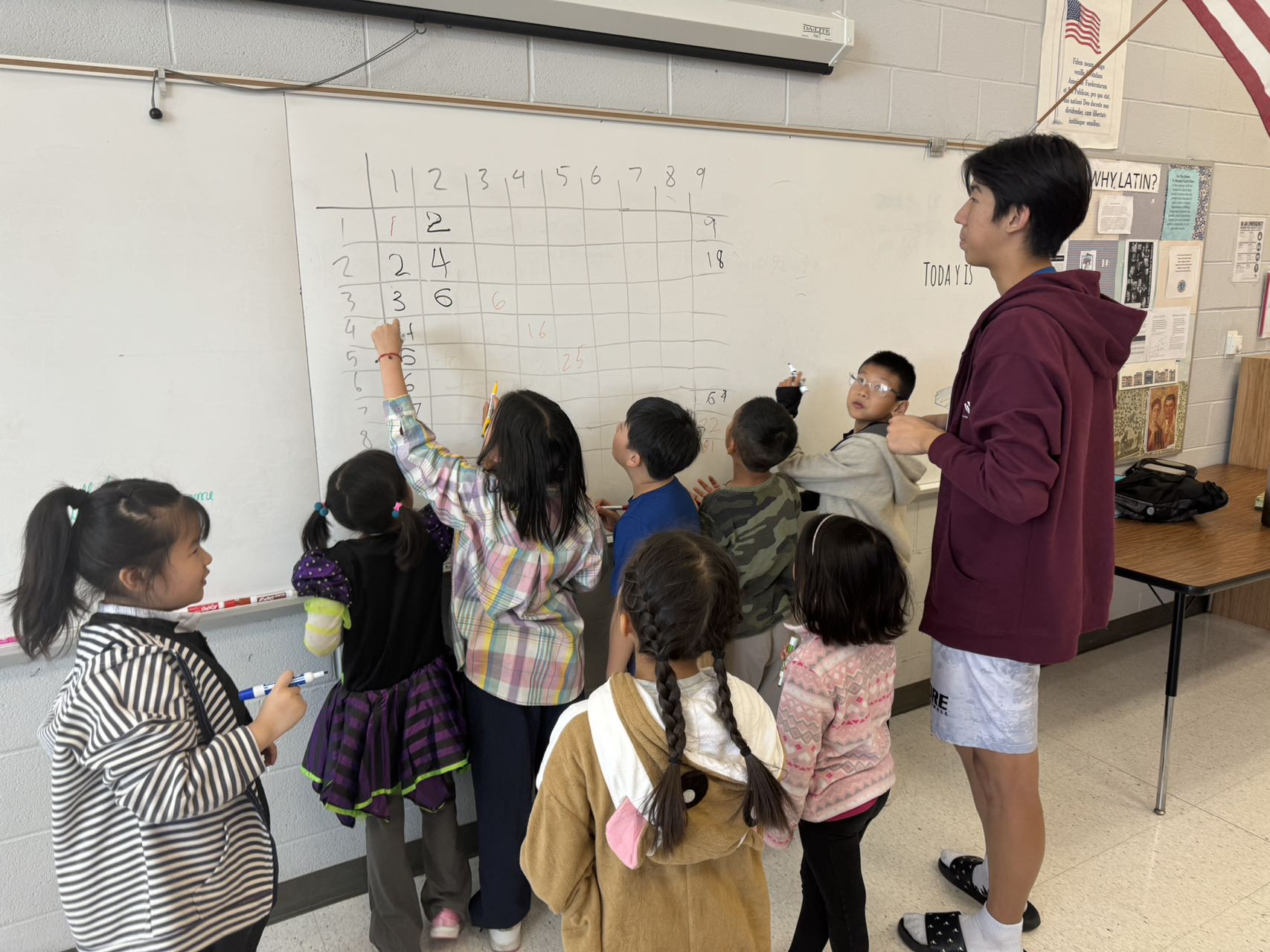
During the 2024–2025 school year, I worked as a teaching assistant for Huaxia School’s “Fun Math” class and co-developed a curriculum for 1st and 2nd graders. Check out the Fun Math class curriculum and have some fun with us!
ACCESS · The Opportunity Gap
The Opportunity Gap
Grades 6–8
By middle school, a student who discovers mathematical problem-solving can enter an extraordinary ecosystem—AMC contests, clubs, books, camps, online communities, and teachers who know where to point next. But access to that ecosystem is uneven. Talent isn’t distributed by ZIP code. Opportunity often is. Geography, school resources, experienced teachers, peer culture, and simple awareness that enrichment exists all shape whether a curious student ever finds the door. My answer to this challenge:
Make resources reachable!
The first step is to make the path visible—free, organized, and ready to use. Introducing two of my projects:
AMC 8 Reorganized
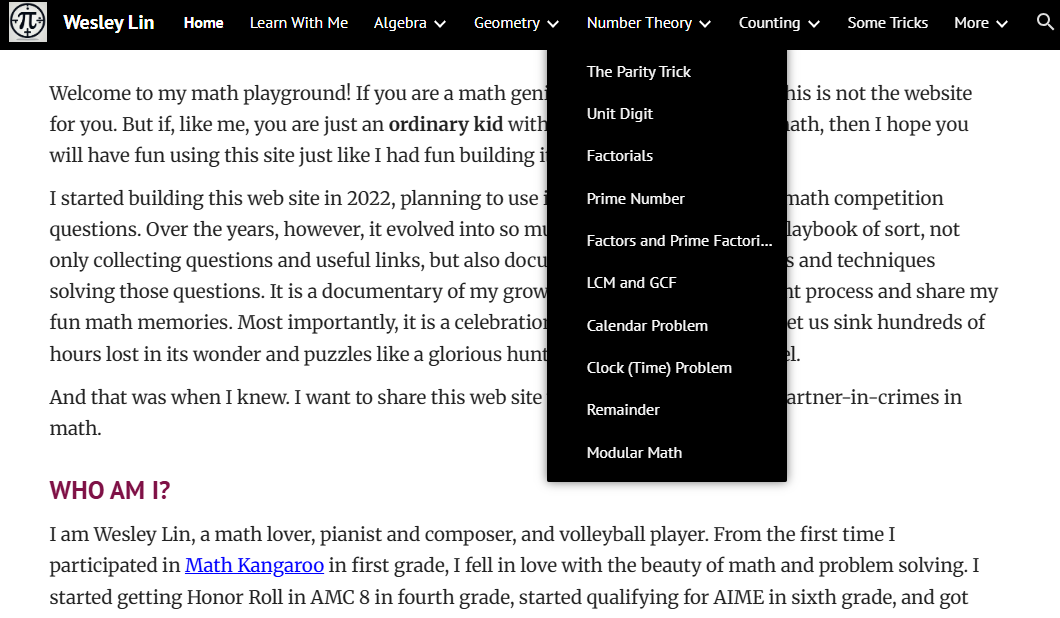
I’ve spent the past few years slowly building this site, organizing AMC 8 problems by idea and topic simply because I enjoyed seeing how the pieces fit together.
In 2025, I developed a one-year curriculum that I had the chance to work through with more than 20 students in grades 5–8 in the Bridgewater Huaxia School AMC 8 class. Many of them went on to earn AMC 8 Honor Roll recognition, which was exciting. But what meant even more to me was watching them become genuinely curious about mathematics and start enjoying the process of solving difficult problems.
I hope this site can give other students some of that same feeling: a place to explore, get stuck, discover patterns, and have fun with math. I hope you enjoy it too!
AMC 10 Reorganized
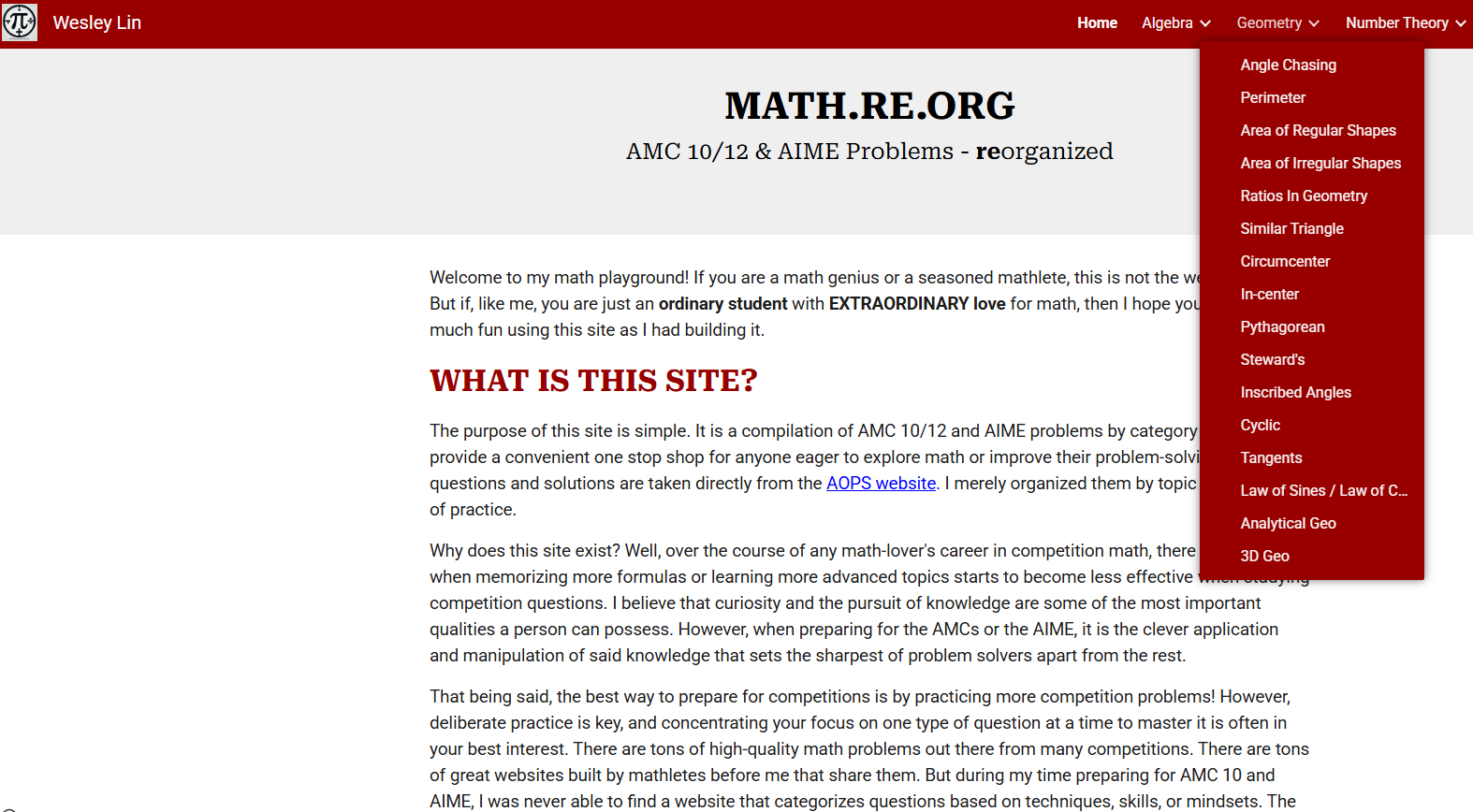
Work in progressAfter building the AMC 8 site, I wanted to keep going. AMC 10 felt like the natural next step: harder problems, richer connections between topics, and a longer runway for students who want to keep exploring.
This one is still a work in progress. There is simply more to sort through, and I want the structure to be genuinely useful rather than rushed. But that is also part of the fun: seeing the same ideas appear in different forms, finding unexpected connections, and gradually turning a large collection of problems into something easier to explore.
My hope is that, just like the AMC 8 site, this can become a place where students do more than prepare for a contest. I hope it helps them discover patterns, build confidence, and enjoy the mathematics along the way.
ACCESS · The Opportunity Gap
When a Website Wasn't Enough
Organizing problems online could remove one barrier. But I kept thinking about students whose schools did not already have the teachers, clubs, mentors, or peer communities that made advanced mathematics feel reachable. That question eventually became Multiply Minds.
Working with NJIT, Newark Public Schools, and LOGISTEM, I helped bring sustained AMC 10/12 instruction to students across Newark. I recruited a small group of fellow math students to help design lessons and teach with me.
What stayed with me most, though, was not the size of the program. It was the students.
They showed up curious, prepared, and eager to wrestle with difficult ideas. After teaching, my friends would tell me that these were some of the most engaged students they had ever worked with, and that teaching them had reminded them why they loved mathematics in the first place.
We went there hoping to share our love of mathematics. Somehow, they gave some of it back to us.
Multiply Minds changed the way I think about access. I used to imagine it as something flowing in one direction—from people who had opportunities to people who did not. Instead, I found that when the right people are brought together, curiosity moves both ways. That, to me, is what a mathematical community should feel like.
EXPLORE · The Depth Gap
The Depth Gap
Grades 9–12
Beyond Solving Problems
Multiply Minds helped me think about who gets to participate in mathematics. My own experiences made me ask another question: what kinds of mathematics do students get to discover?
At HCSSiM and MIT PRIMES, I encountered a world beyond competitions: abstract structures, open questions, and the patient excitement of research. It was where I found my love of pure mathematics.
But friends from competitions told me how disorienting college mathematics could feel. Some struggled with the transition; others left the subject behind. I wondered what might have changed if they had encountered this side of mathematics earlier.
My MIT PRIMES mentor, Kenta Suzuki, helped me imagine a way forward. His generosity as a mentor, and his work bringing advanced mathematics to high school students, made me want to extend the opportunity he had given me.
I was fortunate to find in PRIMES an opportunity that changed how I saw mathematics. I wanted other students with the same curiosity and drive to have a chance to discover what I had found.
That wish became the starting point for SPAN.
SPAN
opening a door for high school students into research
For a high-school student interested in research, the hardest part often is not doing the research. It is figuring out how to begin.
SPAN is my attempt to turn those invisible rules into a pathway.
A free initiative connecting motivated high-school students with professors, Ph.D. students, postdoctoral researchers, and experienced scholars willing to mentor at no cost.
Math is more beautiful when more people get to see it.