Research

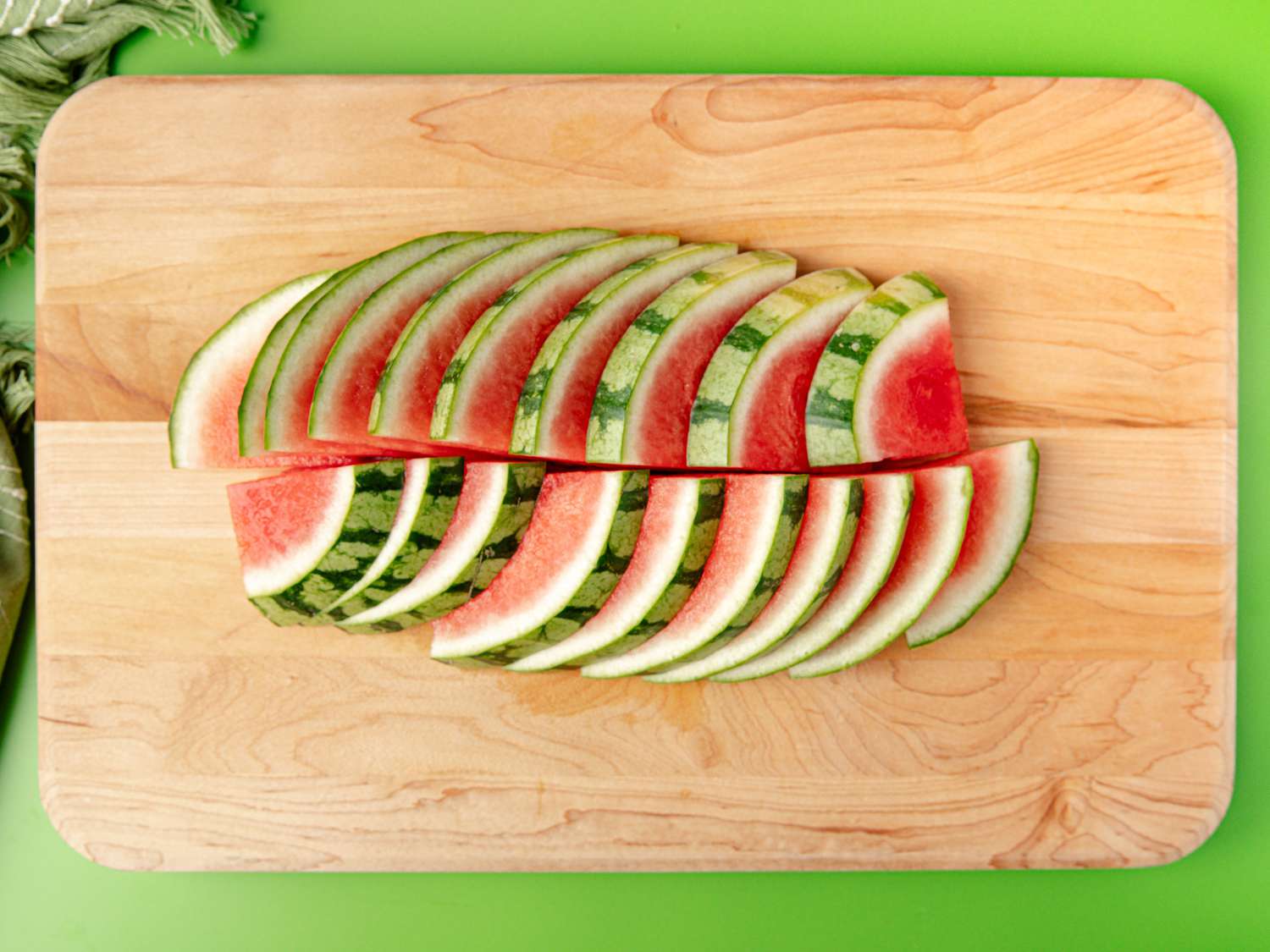
How many pieces can you obtain from a watermelon with n cuts?

I thought I knew how to solve it.

Ninety minutes later, we had barely touched a formula.

It was the first question I encountered during my six weeks at HCSSiM. I was convinced I had seen almost the same problem before, and my mind immediately started racing through formulas and techniques.

But over the next hour and a half, we did not use a single formula. Instead, we asked: What counts as a cut? How does the shape of the watermelon matter? What if the watermelon were four-dimensional?

By the end, I understood the problem more deeply than I ever had before, even without writing down a single equation. That discussion opened a door into a kind of mathematics I had never really experienced before: slower, stranger, more exploratory, and far more joyful.

Watermelon slices arranged on a wooden cutting board

But this was not where my research story began.

↶ Rewind to 9th grade

Episode 1 · Oct. 2024 - Apr. 2025 · Medical AI

Research can change lives.

I am forever grateful to Dr. Liu, Hanrui, and Chu Wen, three wonderful researchers at Center for Drug Evaluation and Research (CDER) FDA who welcomed me into a world I had never known before and showed me how exciting research could be.

I entered the FDA knowing how to solve problems. My mentors began teaching me something different: how to figure out which problems were worth solving in the first place.

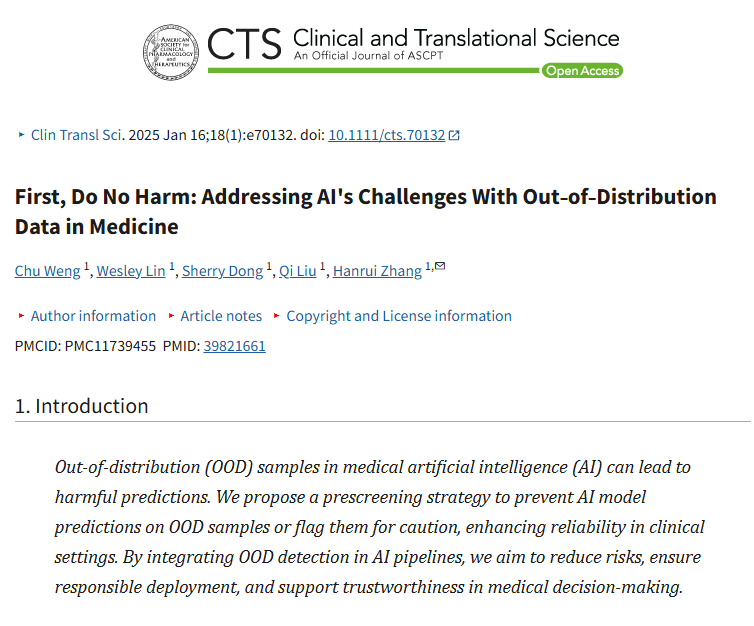
The problem we were investigating began with a question that sounded simple enough, but became more unsettling the longer I thought about it: What happens when an AI model encounters a patient who looks nothing like the data it was trained on? In medicine, a model can perform impressively on average and still fail precisely where reliability matters most. I became fascinated by out-of-distribution (OOD) data—cases that fall outside a model’s familiar training distribution—and joined two studies exploring whether OOD detection could act as a safeguard for medical AI.

For six months, I learned what research looks like before there is a clean answer. I traced ideas through the literature, looking for assumptions, limitations, and gaps in previous work. I worked with real medical datasets, wrote Python code, compared machine-learning approaches, and analyzed how models behaved when the data they encountered began to differ from what they had seen before. When models underperformed, I learned not to treat the result as failure, but as another question: Why? To my own surprise, I had an absurd amount of fun experimenting with the k-nearest-neighbor algorithm, tweaking approaches, interrogating unexpected results, and trying to understand what the numbers were actually telling us.

For the first time, mathematics was not only something beautiful in a notebook. An algorithm I was thinking about could contribute, however modestly, to tools aimed at improving medical AI and understanding diseases such as Parkinson’s.

The work eventually led to publications, but what mattered more was realizing that research could turn mathematical thinking into something that might help another person.

Along the way · two publications

Episode 2 · June. 2025 - May 2026 · Sound × AI × Accessibility

Research can change the way you notice the world.

My next project taught me something unexpected and much subtler: research could change the way I saw something I had taken for granted my entire life.

As a pianist and composer, I had always prided myself on my sensitivity to sound—on noticing musical details, interpreting tone, and hearing nuances others might miss. Working with Professor Mark Cartwright on accessible captioning made me realize how much I had never noticed at all.

We studied how non-speech information (NSI)—music, environmental sounds, tone, background activity, and narrative cues—is represented in captions. Technically, I learned about annotation systems, taxonomies, and large datasets. But what stayed with me most was something more personal. I had always experienced these auditory cues automatically; I had never stopped to consider how much information sound quietly carries through everyday life. I still remember my first meeting with Professor Cartwright, when he turned off the sound of a movie clip with a slightly mischievous smile. Almost immediately, I struggled to understand what was happening on screen, what the characters were feeling, and why their expressions were changing. For a few moments, I experienced how much meaning I had unconsciously been drawing from sound. As a musician, that realization was humbling. Music and sound had always felt so natural and ever-present in my life that I had rarely considered what it might mean to navigate the world without full access to them.

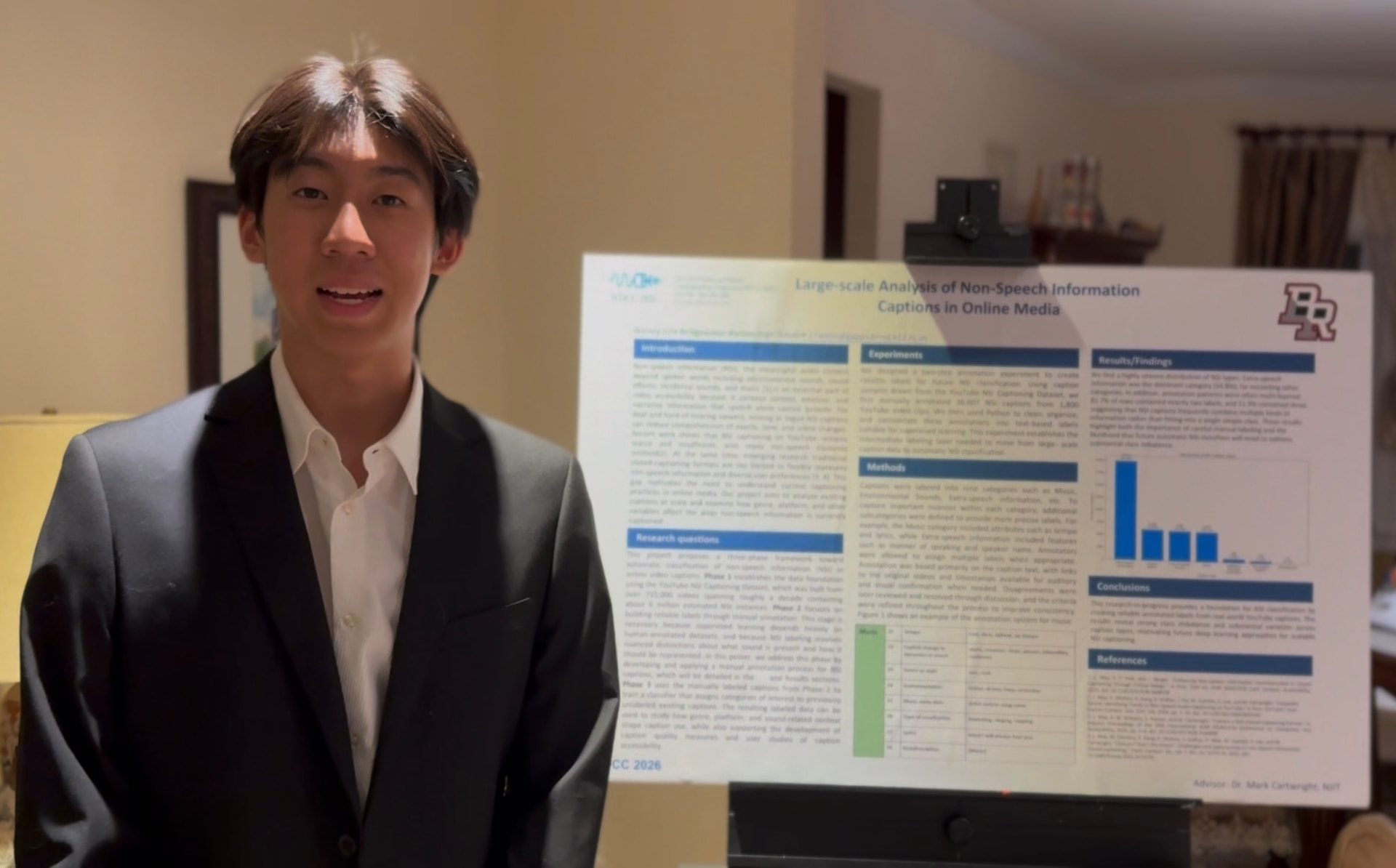
That project changed the way I thought about sound. It no longer felt like background; it felt like information—something many of us receive effortlessly, but that others may not. Presenting our research at IEEE WOCC was especially meaningful because the poster became a starting point for conversations. Fellow high school researchers, university professors, and other attendees stopped to ask questions and discuss how captioning could better communicate the richness of what sound conveys. For me, that was one of the most inspiring parts of research: watching a technical project open into a larger human question about access, communication, and what we can do to make information more complete for people who are deaf or hard of hearing.

Wesley presenting a research poster at the IEEE WOCC conference
Presenting our work at the IEEE International Conference on Wireless and Optical Communications (WOCC) 2026 — I was grateful when the poster received an Innovation in Design Poster Session Award.

Episode 3 · HCSSiM · Pure Mathematics

When the Question Itself Became Enough

I loved that my research could matter. I loved the people I worked with, the new ideas I encountered, and the satisfaction of producing something tangible: papers, presentations, models, results.

But gradually, I noticed something about my own excitement.

Much of it came from what the research could do.

That mattered to me (and it still does!) But I was also searching for another feeling: the urge to keep thinking about a question even when there was no obvious application waiting at the end of it.

I wanted to know whether an idea itself could be enough.

At HCSSiM, I found out.

What captivated me there was not the satisfaction of producing a useful result. It was something much stranger: the joy of not knowing.

During my second week, I went seven days without solving a single major problem on the daily sets. Every night, I made observations, noticed patterns, formed conjectures, disproved them, and started again. I knew my usual ways of thinking were not working. What I did not yet know was what should replace them.

At first, that uncertainty was maddening. Then, slowly, I began to enjoy it. I was learning how to be lost. Eventually, I broke through and solved one of the major problems. But the solution itself is not what stayed with me. What stayed with me were the hours before it: wandering through examples, following ideas that failed, discovering small structures that led nowhere, and continuing anyway.

Those hours taught me that mathematical progress is not simply a sequence of clever insights. It grows out of uncertainty, persistence, failed conjectures, and the willingness to remain with a question long before you know whether it will yield anything at all.

For the first time, I understood that mathematics could be meaningful in two very different ways.

Sometimes, its beauty lies in what it allows us to do. But sometimes, its beauty lies simply in what it allows us to see.

In a sense, HCSSiM brought me back to the kid on the YMCA floor — the one who did not need a prize, a publication, or an application. He just wanted to make sense of the strange pattern hiding in the chaos of tiles.
Episode 4 · MIT PRIMES · Knot Theory

Then I got to stay in the unknown.

01 · The question

When are two knots really the same?

I study ways of translating knots into algebraic objects that can be compared and understood. The precise technical description will evolve as the project does, but the guiding question is simple: what structure survives when a knot is stretched, rearranged, and viewed from another angle?

02 · The objects

Loops, crossings, and braids

knots → braids → algebra

03 · The rabbit hole

One idea kept opening into another.

Knots→Braids→Alexander polynomial→Representations & algebra

Each translation gave me a new language for seeing the same object. The pleasure was not only in arriving somewhere, but in discovering how unexpectedly the paths connected.

04 · The moment I got stuck

The promising approach that wasn’t.

Insert specific PRIMES stuck / breakthrough story here

A future account of what failed, why it failed, and what the wrong turn revealed.

The result · secondary to the road

A result still taking shape.

Paper title, theorem or result summary, and presentation link will live here when the work is ready to share.

At the FDA, I learned that research begins by finding a gap. At PRIMES, I learned something harder:

Sometimes you don’t know what the gap is until you’ve spent weeks staring at the wrong question.

But the more I fell in love with pure structure, the less convinced I became that “pure” and “applied” were really opposites.

Connection · Episode 5 · NJIT · Mathematics × Physics

What if abstraction could describe something real?

After PRIMES, another project made the boundary between pure and applied mathematics feel even blurrier.

Working with Professor Daniel Massatt at NJIT, I began studying a deceptively physical question: How do electrons behave in a discrete ring of atoms?

But as I went deeper, the atoms began to disappear.

Underneath them were matrices. Eigenvalues. Fourier modes. Spectral structure.

I used abstract linear algebra, spectral theory, multivariable calculus, and Fourier analysis to study eigenvalue corrections in a tight-binding model of an atomic ring.

What fascinated me was not simply that abstract mathematics had suddenly become “useful.” It was that structures I found beautiful in their own right could also describe the physical world.

H ψ = E ψ

The boundary between pure and applied math was beginning to feel much less like a boundary.

And not every pattern lives in an equation.

Some hide in conversations.

Impact · Episode 6 · Interpretable machine learning

Patterns in people

In another project, I worked with 977 anonymous adolescent peer-support conversations, asking a very different kind of question: What makes one conversation more likely to help than another?

This time, the patterns were behavioral and linguistic.

I led the quantitative modeling and evaluation, using interpretable approaches including logistic regression and decision trees alongside neural-network models to look for features associated with positive conversational responsiveness.

But here, finding a predictive pattern was not enough.

I wanted to understand what the model thought it was seeing.

A coefficient was no longer just a coefficient. A feature might reflect how someone listened, responded, or helped another person feel heard.

The work eventually became “Predicting Positive Outcomes in Anonymous Adolescent Mental-Health Peer Support: An Interpretable Machine-Learning Study,” presented at the 2026 IEEE MIT Undergraduate Research Technology Conference.

conversation features→model→likelihood of a positive response

Sometimes finding structure helps us understand an abstract object.

Sometimes it helps us understand one another.

Other places the pattern has taken me

Survival analysis — Memorial Sloan Kettering Cancer Center

Explored time-to-event oncology data using Kaplan–Meier analysis and Cox proportional-hazards models to study patient risk and survival trajectories.

Learn more →

So which kind of mathematics do I want to do?

For a while, I thought I needed an answer.

Pure mathematics gave me the intoxicating freedom to follow structure simply because it was beautiful.

Applied mathematics showed me that those same structures could describe physical systems, improve models, and sometimes help us understand people.

I increasingly think the distinction matters less to me than I once assumed.

What keeps pulling me back is the same instinct:

there is something here.

A knot. An atomic ring. A dataset. A conversation.

Something underneath the surface has structure.

And I want to see it.

Knot
Atomic ring
Data
Conversation

Sometimes understanding the pattern is the destination.

Sometimes it becomes a tool for something larger.

I want room for both.

Different questions. Different languages. Same instinct.

Look closely enough, and there might be a pattern underneath.